AI Governance: A Definitive Guide (2026)


Most organisations did not actively decide to adopt AI, they simply discovered that they already had.
A marketing team starts drafting campaign copy in a consumer chatbot. A developer connects a coding assistant to a repository holding proprietary logic. A recruitment platform quietly ships a new candidate-ranking feature.
We spent six weeks measuring what this looks like in practice, inspecting AI traffic across our customers’ mobile fleets. 84% of those customers had AI traffic on the fleet. More telling, 69% of the AI domains we detected were ones we had never seen before. Most of that activity never reaches the tools security teams already run.
This is the gap AI governance exists to close. Adoption has outpaced oversight. The systems now shaping consequential decisions were often introduced with no risk assessment, no owner, and no record that they exist at all.
What is AI governance?
AI governance is how an organisation makes sure its AI systems stay safe, transparent and aligned with business goals. It covers the policies, processes, controls, roles, standards and technologies applied as AI is built, bought, deployed, and monitored.
It answers four questions on a continuing basis. Which AI systems do we have? Who is accountable for each one? What could go wrong? And how would we know if it did?
A policy that says AI must be used ethically creates no capability. Governance is the machinery that turns that intent into evidence. It means an inventory that is up to date, and a review step a system cannot skip on its way to production. It means monitoring that catches drift, and an escalation path that works at 4 PM on a Friday.
How AI governance relates to adjacent disciplines
These terms get used interchangeably in vendor material, which causes real confusion in procurement conversations. They are distinct.
- AI ethics: What an organisation should and should not build or use. It supplies the values that governance turns into rules.
- Responsible AI: The practice of building and running AI to meet those values. Governance is what makes it repeatable rather than dependent on individuals.
- AI risk management: Finding, judging, treating and tracking AI-specific risks. It is a core function inside governance, not a substitute for it.
- AI security: Protecting AI systems and their data from attack and accident. It covers prompt injection, model theft, data exfiltration and supply chain risk.
- Data governance: Where data came from, how good it is, and what it may be used for. Without it, AI governance cannot be enforced.
The practical implication is that AI governance should extend existing structures rather than replace them. Build a parallel stack alongside security, privacy and model risk, and you get duplicated evidence, clashing approvals, and a programme nobody outside the governance team can navigate.
Why is AI governance important?
Managing risk before it becomes an incident
AI risk is not hypothetical. Recruitment tools have learned gender preferences from past hiring data. Chatbots have committed organisations to refund terms they never meant to offer. Legal filings have reached court citing cases that a generative tool simply invented.
Each of those was a governance failure, not a technical one. The system worked as designed. What was missing was a human check sized to the stakes of the output.
Protecting sensitive data at the point of use
Data leakage into AI tools is now one of the most common ways confidential information leaves an organisation. Cisco’s 2026 Data Privacy Benchmark Study found that more than half of employees admitted typing non-public company information into generative AI tools. Close to a third had entered details about customers or colleagues.
Most consumer AI services carry no data processing agreement, no retention commitment and no data residency guarantee. Consider an employee subject to GDPR who pastes customer records into a personal chatbot account. They have just sent personal data to a third party, possibly across a border, with no lawful basis and no record of it.
Governance works at three levels here. First, a sanctioned toolset with contractual protections in place. Second, technical controls that show security teams which AI services are actually in use. Third, classification rules that set out what may be sent where.
Preventing bias and unfair outcomes
Bias in AI is rarely deliberate. It is usually inherited from training data that reflects historical patterns. It can also enter through proxy variables that track protected characteristics.
Governance turns fairness from an intention into a measurement. That means agreed fairness metrics for the context, testing before deployment, monitoring for unequal outcomes afterwards, and a documented route to fix problems.
The same logic applies to explainability, and the requirement scales with consequence. Where a decision materially affects someone, you need to be able to say in plain language what drove that outcome. Build that in from the start. It cannot be bolted on after a complaint arrives.
Creating accountability for AI decisions
The most damaging gap is diffuse ownership. A model gets built by data science, deployed by platform engineering, embedded in a product owned by a business line, and bought through a vendor. Accountability can dissolve at every handover. Governance names one accountable owner per system, and that person answers for how it behaves regardless of who built it.
Enabling AI to scale
The strongest argument for governance is commercial rather than defensive. During experimentation, exposure is small and governance feels like friction. The calculation changes when AI is used in revenue, hiring, credit, clinical or safety-related workflows. In these cases, the system becomes load-bearing.
At that point, organisations without governance hit a wall. Legal, security or the board blocks further deployment, because nobody can state the risk position. Governance clears that blockage. Give teams a clear approval route, a defined risk tier and known controls, and they ship AI faster, because they are not renegotiating the rules every time.
What is an AI governance framework?
An AI governance framework is a structured model for how governance actually gets done. It sets out the processes that apply at each stage of the AI lifecycle, the roles that hold decision rights, the controls that reduce known risks, and the records that show all of it happened.
Almost every large organisation has published AI principles. Very few have made them operational, and the gap between the two is where frameworks do their work.
|
Stated principle |
The question it leaves unanswered |
|---|---|
|
“Our AI will be fair” |
Fair by which measure, across which group, at what threshold, tested by whom, how often? |
|
“Our AI will be transparent” |
Transparent to whom, showing what, in what form, at what point in the interaction? |
|
“Humans remain in control” |
Which decisions need human sign-off, what does the reviewer see, and what happens when they disagree? |
A framework answers those questions once, in a way that holds across the organisation, so individual teams are not improvising.
Proportionality is what makes a framework usable
One design decision determines whether a framework survives contact with the business, and that is proportionality. Put a tool that summarises public articles through the same review as a model that shapes credit decisions, and teams will route around governance entirely. The organisation then loses the visibility it was trying to gain. Make every control light, and serious risks go unexamined.
Risk-tiering at intake solves this. A short triage step sets a tier based on what happens if the system is wrong. The tier then drives how deep the assessment goes, who has to approve it, and how closely it is monitored. Low-tier systems clear in days against a standard control set. High-tier systems get the scrutiny they warrant.
Governance across the AI lifecycle
Frameworks organise controls around lifecycle stages, so the right question gets asked while it can still change the outcome.
-
Ideation: Is AI the right tool here? This question gets skipped more than any other. A rules-based workflow, a better-designed form or a dashboard is often more accurate, cheaper to run and easier to govern than a model. Choosing not to use AI is a legitimate governance outcome.
-
Data sourcing: Where the data came from, whether its use is permitted, and which population it actually represents. Get this wrong and you cannot fix it later without retraining.
-
Build or procure: For work built in-house, what gets tested and documented. For bought-in systems, what the vendor must prove and what the contract must require.
-
Validation: Testing for performance, robustness, fairness and security. Agree the pass criteria before the work starts, not after you see the result.
-
Deployment: Sign-off by the accountable owner, disclosure to the people affected, and human oversight in place before the system reaches live users.
-
Operation and monitoring: Drift detection, sampling of outputs, open incident channels, and periodic review against the original criteria.
-
Retirement: A model whose business purpose has quietly disappeared stays a liability while it stays connected. Retiring it means removing access and integrations, deciding what happens to the data and to past decisions, and keeping records for as long as the rules require.
AI governance framework examples
Four reference points dominate practice, and they complement each other rather than compete. That is the most common misunderstanding in governance procurement.
-
NIST AI RMF 1.0 is a voluntary US framework built on four functions: Govern, Map, Measure and Manage. It suits organisations that want a practical risk method without the overhead of certification. Its Generative AI Profile (NIST AI 600-1) covers GenAI-specific risks.
-
ISO/IEC 42001:2023 is a certifiable management system standard. It suits organisations that need assurance an outside auditor can sign off, and AI vendors selling into regulated buyers.
-
OECD AI Principles are intergovernmental principles. They are useful for setting values, and for understanding the thinking most national regimes were built on.
-
EU AI Act is binding, risk-tiered law. It applies to anyone placing AI systems on the EU market, or whose AI output is used there.
The combination that works: ISO/IEC 42001 for the management system, the NIST AI RMF for the risk method inside it, and both mapped to whatever regulation applies. One control library, several assurance outputs.
Where regulation currently stands
The EU AI Act is the most comprehensive regime in force. It sets obligations by the risk a system poses, not the technology it uses. Its reach extends past the EU. A provider based anywhere is in scope if its system reaches the EU market, and so is one whose output is used there. What you owe depends heavily on whether you are a provider or a deployer. Penalties reach €35 million or 7% of global turnover at the top tier.
Elsewhere the picture is less settled. The United States has no comprehensive federal AI statute, so binding duties on private firms sit mostly in state law. That makes US exposure a moving patchwork rather than one standard to build against. The UK has told existing regulators to apply AI oversight inside their own remits instead of passing a single statute.
Sectoral rules matter as much as AI-specific ones everywhere. Financial services model risk expectations, medical device regulation, employment law and data protection law all bite on AI systems, whatever any AI Act says.
Key components of an effective AI governance framework
|
Component |
Why it matters |
What it looks like in practice |
|---|---|---|
|
Strategy and policy |
Without a stated risk appetite, every decision gets negotiated from scratch |
Permitted uses, banned uses, approval thresholds and data handling rules, backed by executive leadership and written with real examples |
|
Structure and accountability |
Decision rights have to sit somewhere specific |
A cross-functional body that can approve, pause and demand changes, plus a named owner for each system |
|
AI inventory |
Shadow AI means the real estate is bigger than the known one |
A register of purpose, risk tier, owner, data, models, vendors and approval status, filled in by discovery tooling rather than surveys |
|
Risk and impact assessment |
Proportionality needs a trigger point |
Triage at intake sets the tier. Deeper assessment, including fundamental rights and data protection impact, is kept for higher tiers |
|
Data governance |
Provenance and permitted-use failures cannot be fixed after training |
Classification, lineage tracking, a documented consent and licensing basis, and checks on quality and representativeness |
|
Model governance |
Versions change, and undocumented changes defeat audit |
Version control, recorded validation results, agreed pass criteria, change approval, model cards |
|
Vendor oversight |
Outsourcing the technology does not outsource the accountability |
Contract terms on training use of your data, retention and deletion, proof of the vendor’s own testing, incident notice duties, audit rights, exit terms |
|
Transparency and explainability |
Reviewers and affected people both need to understand the output |
AI disclosure in interfaces, marking of synthetic content, explanation methods sized to the consequence |
|
Security and privacy controls |
AI widens the attack surface and opens new exfiltration paths |
Access controls, prompt injection defences, output filtering, data minimisation, DLP that covers AI destinations, vendor security review |
|
Human oversight |
The control most often claimed and least often working |
Defined intervention points, reviewers with the information and authority to override, and measurement of whether overrides happen |
|
Monitoring and auditing |
Performance drifts and controls decay quietly |
Drift monitoring, output sampling, periodic control testing, retained audit evidence |
|
Incident management |
AI incidents rarely look like outages, so standard detection misses them |
AI-specific incident definitions, reporting channels open to staff and customers, response playbooks, triggers for notifying regulators |
|
Training and AI literacy |
Most exposure starts with ordinary users making reasonable-looking decisions |
Training by role, covering permitted tools, data handling and the duty to verify |
Who should oversee AI governance?
AI governance owned by IT alone fails predictably. IT can see the systems. It cannot judge whether a hiring model is lawful, whether a clinical decision aid is clinically sound, or whether a pricing model is fair. AI risk is technical, legal, ethical and commercial at the same time. Oversight has to be cross-functional, with decision rights that are clear rather than vaguely shared.
Most organisations settle on three layers. A governance committee sets policy and rules on high-risk cases. A working group handles assessment and technical review. Accountable owners inside business lines run individual systems. The committee should be small enough to decide and senior enough that its decisions hold. Smaller organisations do not need a committee, but they still need someone named.
Questions to answer before deploying an AI system
If a team cannot answer these, the system is not ready for production, however well it performed in testing.
- Is AI the right tool for this purpose, and who is the named accountable owner?
- What data does it use, is that use permitted, and does the data represent the people it will be applied to?
- Who could be harmed if it is wrong, how badly, and how would we spot unequal outcomes between groups?
- What human oversight applies, and does the reviewer have the information and the authority to disagree?
- What gets monitored after launch, at what thresholds, who acts on it, and what is the rollback plan?
Common failure patterns
Five patterns recur across governance programmes that stall.
- The inventory that was accurate once: Built from a one-off survey, it captures the known systems and misses the rest: anything bought on an expense claim, switched on as a feature inside existing software, or used through a personal account. Our six-week measurement showed what sits in that gap. OpenAI showed up in around a third of accounts, but the rest was made up of services most security teams would not recognise – Bloomreach, Emarsys, Sprig, Sendbird, Gorgias, alongside AI features that arrived as routine updates to software the business already trusted. Nobody procured those. Nobody reviewed them. None of them would appear on a survey, because most of the people using them do not know they are using AI at all. Inventories need continuous discovery, not annual attestation.
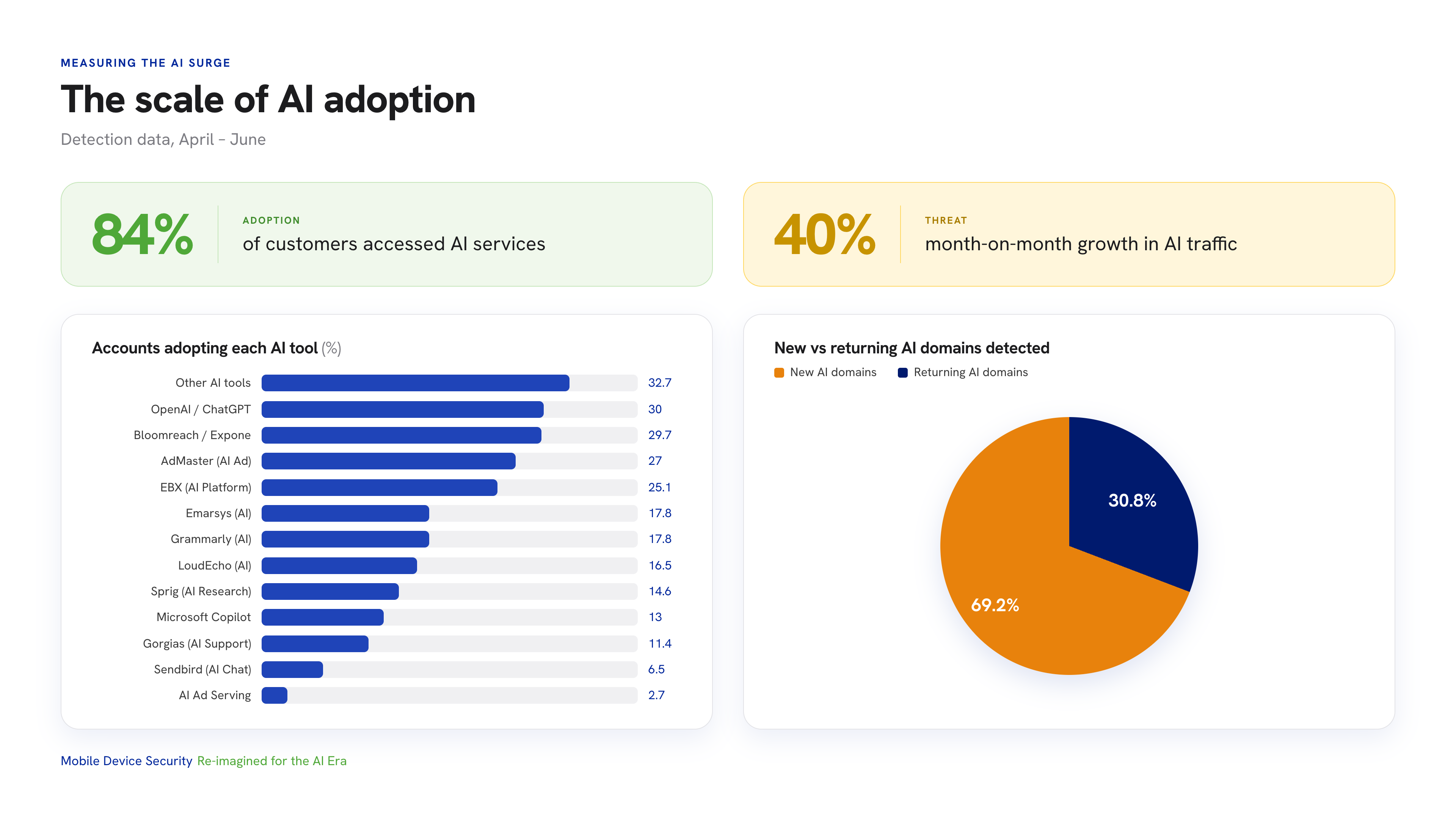
Measuring the AI surge: the scale of AI adoption on mobile fleets
|
Finding |
Result |
|---|---|
|
Customer accounts where AI services were accessed |
84% |
|
Month-on-month growth in AI traffic |
40% |
|
Detected AI domains that were new to Corrata |
69% |
|
Detected AI domains already known to Corrata |
31% |
AI tools detected, by share of customer accounts
|
AI tool |
Accounts where detected |
|---|---|
|
OpenAI / ChatGPT |
30.0% |
|
Bloomreach / Exponea |
29.7% |
|
AdMaster (AI advertising) |
27.0% |
|
EBX (AI platform) |
25.1% |
|
Emarsys |
17.8% |
|
Grammarly |
17.8% |
|
LoudEcho |
16.5% |
|
Sprig (AI research) |
14.6% |
|
Microsoft Copilot |
13.0% |
|
Gorgias (AI support) |
11.4% |
|
Sendbird (AI chat) |
6.5% |
|
AI ad serving |
2.7% |
|
Other AI tools |
32.7% |
Accounts commonly use more than one service, so these shares do not sum to 100%.
Methodology: Corrata inspected AI-related network traffic across customer mobile fleets between April and June 2026. Detection is based on on-device inspection of connections to known and newly identified AI service domains. Percentages show the share of customer accounts in which traffic to each service was observed.
- Human oversight in name only: Picture a reviewer approving hundreds of model recommendations a day, seeing nothing beyond the recommendation itself, with no real authority to disagree. That is documentation, not a control. Measure override rates. A rate near zero means the control is not working.
- Governance as a gate rather than a service: If the only contact teams have with governance is a slow approval queue, they will route around it. The programmes that hold up offer pre-approved tooling, reusable assessment templates and fast triage for low-risk cases.
- Vendor opacity accepted by default: Plenty of suppliers will not disclose their training data practices, test results or model limits. The usual response is to proceed anyway, because the tool is already in the budget. The workable position is to accept opacity for low-consequence uses and refuse it for high-consequence ones.
- Framework compliance without risk reduction: You can assemble a complete ISO/IEC 42001 evidence pack while the riskiest system in the organisation runs unassessed on a business line’s own budget. Certification shows a management system exists. It does not show that the system covers everything.
Where to start
Maturity varies, but the sequence that fails least often is the same. Build an inventory of the AI already in use, including tools nobody approved. Publish a policy on permitted use, data handling and approval thresholds. Add risk triage at intake, so the depth of review matches what happens if you get it wrong. Then apply controls to the top tier first.
The order matters more than it looks. Organisations that start with controls end up applying them to a fraction of their AI estate, and never find out which fraction.
It also matters where the inventory comes from. On the evidence of our own fleet data, a policy written against a list of declared AI tools is governing a minority of the AI actually in use. The list has to be built from what is happening on the network and on the devices, not from what people remember to report.
Frequently Asked Questions
Keeping AI systems trustworthy and accountable across their whole life, from the decision about whether to use AI at all through to retirement. It is broader than compliance, and broader than ethics. In practice the focus is a repeatable process, so decisions about AI stay consistent instead of being made case by case.
Keeping AI systems trustworthy and accountable across their whole life, from the decision about whether to use AI at all through to retirement. It is broader than compliance, and broader than ethics. In practice the focus is a repeatable process, so decisions about AI stay consistent instead of being made case by case.
Partly. The EU AI Act binds providers and deployers of AI systems used in the EU, and sectoral rules plus US state laws add more duties. Frameworks like the NIST AI RMF and ISO/IEC 42001 are voluntary, but customers, auditors and insurers increasingly expect them.
Responsible AI is the goal: building and using AI in line with ethical and social expectations. AI governance is the machinery that delivers it consistently, through set policies, roles, controls and records.
Most organisations use more than one. ISO/IEC 42001 gives you a certifiable management system. The NIST AI RMF gives you a risk assessment method. Regulation sets the legal floor. Map one control set against every regime that applies, rather than running parallel programmes.
Executive leadership owns the programme and the board approves risk appetite. But effective governance is cross-functional, drawing on security, legal, data protection, risk, engineering and the business lines that own individual systems.